
The Odyssey - If You Want to Read the Book, You Totally Should
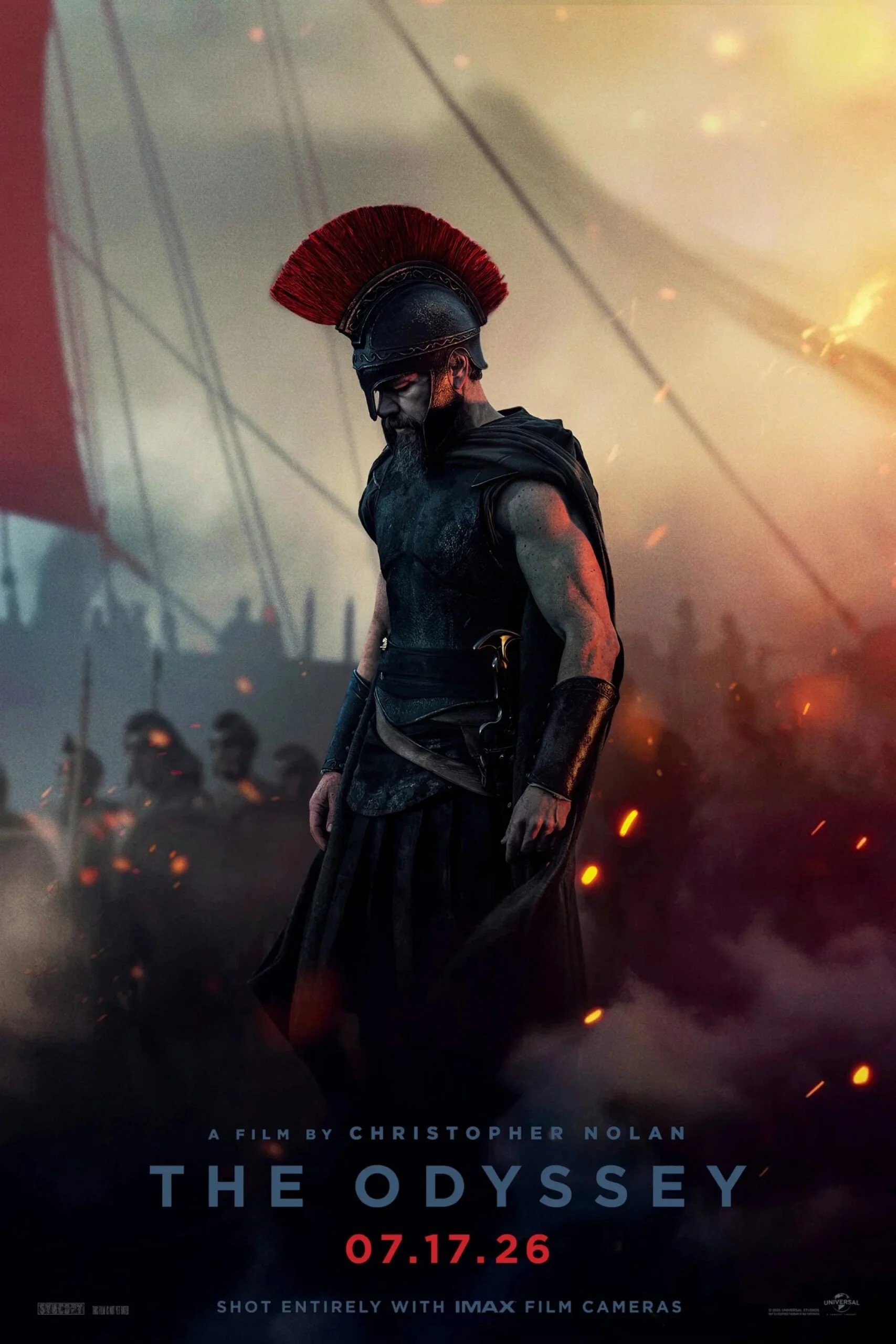
If you want to read the book, you totally should. It’s good. Or it was at least intriguing enough to make people want to make a movie based on it. And while there’s a variety of reasons that this may be the case, if you want to read the book, you totally should.
I was thinking about this after watching The Odyssey. That’s a good movie. This won’t be another piece about whether it was a good movie or not. It was. It wasn’t perfect, but it was good. And any review that strays too far from that premise is being disingenuous for one reason or another. But I was struck by the discussions that surrounded Nolan’s film. A lot of “wouldn’t’ves” and “shouldn’t’ves” and, the most silly one in my opinion, “didn’ts” are floating around out there.
Now the reason I find this so silly- especially the last one- is because, and I cannot stress this enough: it didn’t happen. It didn’t take place. There is a town in modern-day Turkey that was at some point called Troy. It was destroyed multiple times and rebuilt multiple times. That'll happen to you if you're an ancient city. And that’s about it. No Odysseus, no horse, no- and I hope there’s no one who needs this said but I’ll say it anyway- no cyclopses, sirens, or witches.
Okay. Now that that band-aid is ripped off, what are we left with? We’re left with an old story. It’s a very good old story. And we’re left with a new movie. It’s a very good new movie. So what’s the problem here?
I have several theories but for this, I’ll keep it to one and I’ll keep it short. I think the current fan culture surrounding many movie franchises has misled people into thinking that art is a democracy. It isn’t. Not good art. Good art is often a collaboration, but it isn’t a democracy. Movies are famously humongous collaborations that require small artistic choices by many artists. Books are often dictatorships where the author is judge jury and executioner or, at most, monarchies where the author is a powerful king but his courtiers and lords (publishers and editors) make significant steers. Once art becomes a democracy, it ceases to be art and becomes a diner menu. There’s nothing wrong with a diner menu. If there’s only one spot open in town when you stop for the night on your long drive from Chicago to Boston, you want it to have eggs, a taco bowl, a Greek salad, and a turkey sandwich to choose from. There’s a legitimate reason to cater to the hundreds of people passing through Rochester, NY at all hours of the day. But if I called myself an artist for writing a diner menu, you’d be right to scoff.
Art should have something to say. Even if that thing is only a painter saying “isn’t this sunset beautiful?” It’d be stupid for the painter to change his painting one iota just because someone says “that’s not what the sunset looks like from my house.” Okay. Well that’s what the sunset looks like from his house. Or- and this is maybe an even more important point- this is what the sunset looks like to him from his house.
When movies are created based on books, they become a new piece of art. The book was a piece of art, now the movie is a new piece of art. They become a collaboration- sometimes involving the author, sometimes not- with actors, producers, set designers, costume designers, lighting technicians, make-up artists, foley artists, and many others all with the director at the helm. And when they become this new piece of art with this beautiful amalgamation of new artists, they make new artistic choices and they have something else to say. Often- and especially with adaptations of more recent literature- what they have to say is very similar. That makes sense. They’re from the same time. But changes are made. Movies are a visual medium. If for no other reason than to be more appealing to look at and to fit into a reasonable run-time, changes should and are made that alter the source material.
Some changes are good and some changes are bad. Famously good changes in adaptations include omitting Tom Bombadil from the Lord of the Rings series. Not that he isn’t a beautiful, colorful, and fascinating character, but because, especially in a cinema with people unfamiliar with Tolkien’s lore, he’d have undercut the seriousness of the situation and slowed the plot down. Another great choice was in The Shawshank Redemption where, although it was terribly heartbreaking, they have the old convict, Brooks, kill himself instead of slowly dying of old age. Hanging himself because he can’t cope with the outside world is a much stronger image for a visual medium. And there’s bad changes. The mischievous, sneaky, swashbuckling bandit Robin Hood, who famously shot a bow and arrow and flitted amongst the trees of Sherwood Forest, for some reason defended a fucking beachhead on horseback with a sword and an army in Ridley Scott’s 2010 film Robin Hood. A famously awful choice in adaptation was in Harry Potter and the Deathly Hallows Part Two where Voldemort disintegrates into a million pieces when he dies and the pieces float majestically away which- if I saw that from a dude who famously kept coming back to life after disappearing, I would assume, after this latest majestic and magical looking disappearance, that he was definitely coming back to life. This missed the whole point that a seemingly immortal creature was, in truth, just a man whose small body was, in JK Rowling’s novel, tossed unceremoniously in some random chamber out of the way. He tasted death like everyone else. Well. Everyone except on-screen Voldemort who is still probably floating around out there in the ether.
Bad changes miss the point of the characters or circumstances in which the story takes place. Good changes make the story more suitable for a visual medium or find a new lens through which to thoughtfully view the source material.
This brings us back to The Odyssey. Author L.P. Hartley once said, “the past is a different country, they do things differently there.” I think this is a good one to bear in mind as we discuss The Odyssey. The distinct piece of art that was The Odyssey in the 7th century BC was a strong piece that had something to say. But what it had to say isn't something any of us would recognize. Homer’s Odysseus didn't feel remorse for his actions because the Greeks of that time did not balk at killing for glory. Alexander the Great 400 years later purportedly carried The Illiad, also by Homer, with him at all times. Alexander the Great is many things to many different people but he is, without a doubt, one of the world's most famous butchers who was driven, even more than the average conqueror, by ideas of Homeric glory. Homer’s writing in both The Illiad and The Odyssey talk about the gods, not as literary devices through which the human characters explore their own motivations, but as powerful characters who move the plot forward with their supernatural powers and crude whims. The term “Deus ex machina” refers to the tendency in ancient Greek stories, specifically plays, to have a God appear out of nowhere without context at any point anywhere else in the plot and just fix or blow up someone's plans. Why? Because they can. And when you're writing about gods who cause thunder, lightning, tides, sun, volcanoes, earthquakes, miscarriages, fear, illness, and so much more out of nowhere in your very real life, that makes sense. That’s a reasonable way to write those characters. When those gods, in 2026, have become just silly myths to you, that’s just considered lazy writing.
The Odyssey is a wonderful story that was very indicative of its time. I’m not here to pass judgment on it. It should be studied and enjoyed for what it is. If you want to read the book, you totally should. But make no mistake about what it is. It's the story of a man who is extremely comfortable with killing for glory- an act not remotely condemned or second-guessed- and whose fatal flaw was hubris and he dooms his crew because he shoots out the eye of the cyclops who is the son of Poseidon and then taunts the blind beast by shouting his name back to him as he sails away. The distinct work of art that is Homer’s Odyssey has something to say. That thing is that cunning and intellect will help you find glory and will help cities fall before you, and that's all good, just don't piss off the gods. Not metaphorically, not allegorically, the message of Homer is genuinely don't piss off the very real gods that tangibly rule over all of us, the Greek people. One of the reasons Homer’s work played so well to the ancient Greeks is because it's very likely that the average person in Homer’s time would have been what we'd see as almost religious zealots if they were alive today who were far more comfortable with violence as a conduit to self-aggrandizement.
Here in 2026, if a writer/ director wrote a story about a good guy who tricks lots of innocent people to get in their homes, murders those people, is praised for it, but then is foiled, not because of someone else's goodness or compassion, but because he shot sasquatch who happened to be Santa Claus’s son, you might not see that movie. Or you would but you'd laugh at how ridiculous it is. But either way you wouldn’t take it as a deeply serious moralistic tale. Because we do things differently here. For Nolan to deliver a blow by blow of a story like that would be, on his part, incredibly lazy. It is, objectively, a far more intelligent, nuanced, and artistically significant move for Chris Nolan to engage with the material the that way he did.
Nolan loved the original story. He loved the cyclops and the wooden horse. He loved the giants and the sirens. We all do. That’s why we feel so strongly about an adaptation. So he did what good adaptors do. He found a new lens through which to thoughtfully view the source material. He asked “what if Odysseus had felt bad for what he had done?” He asked “what if Zeus’ law could be extrapolated out and could find common ground with the values and the culture that we hold to today?” And then he asked an interesting question that might be more salient to our time, “what if the people living in a time of rapid societal change that may not be for the best, what if those people knew what was happening? What if those people blamed themselves? What then?”
And that’s art. That’s beauty. Concerning one’s self with the minutia of the “would haves”, “should haves”, or “could haves” of a two and a half thousand year old fictional story is just asinine. They didn’t. Helen wasn’t white because she didn’t exist. They didn’t speak formal English, informal English, archaic English, or English at all because the author wrote in ancient Greek. And Calypso isn’t a Jamaican voodoo princess from Pirates of the Caribbean because she’s a nymph and nymphs don’t exist. So here, in this beautiful work, the people look and sound the way they look and sound because that’s the way they are. This Odysseus laments the world he helped bring to an end. He is afraid he’s offended a God with the values of honor and compassion. And the people of Ithaca wonder how they will survive in this new world that their leaders have created. Sounds familiar? It stays true enough to the magic and beauty of the original story but through a new lens asks important questions of us, the modern audience. Because that’s what good art does. It has something to say. It isn’t a democracy. It asks for you to engage with it on its own terms. Only cowards duck for the cover of “well it wouldn’t have happened like-” well what if it did? What if it did? There’s such a thing as missing the point when changing material, but Nolan didn’t. The people who cling too closely to the minutia of a story they likely don’t understand miss the point.
But if I’m wrong, that’s fair enough. I’ve been wrong before. But that’s okay because the values of Ancient Greece still exist in a work of art somewhere. The base desires of the old gods, their wrath, the bloodshed for personal glory, it all still exists. It exists in Homer’s Odyssey. It’s in the book. If you want to read the book, you totally should. It’s good.